The Iconic Symbolism of Nataraja
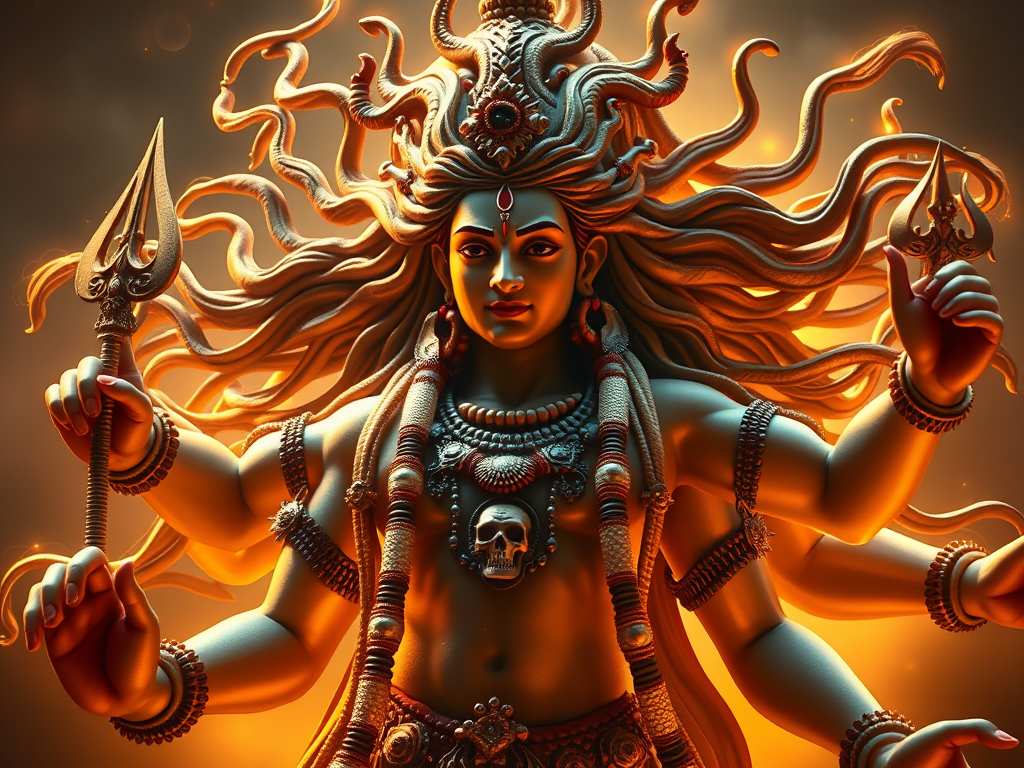
The Nataraja avatar of Shiva, often hailed as the “Lord of Dance,” presents a rich panorama of symbolism that encapsulates the fundamental principles of Sanathana Dharma cosmology and spirituality. Every aspect of the Nataraja iconography, from the dynamic posture to the objects held and the surrounding elements, carries profound meaning, offering a glimpse into the multifaceted nature of the divine.
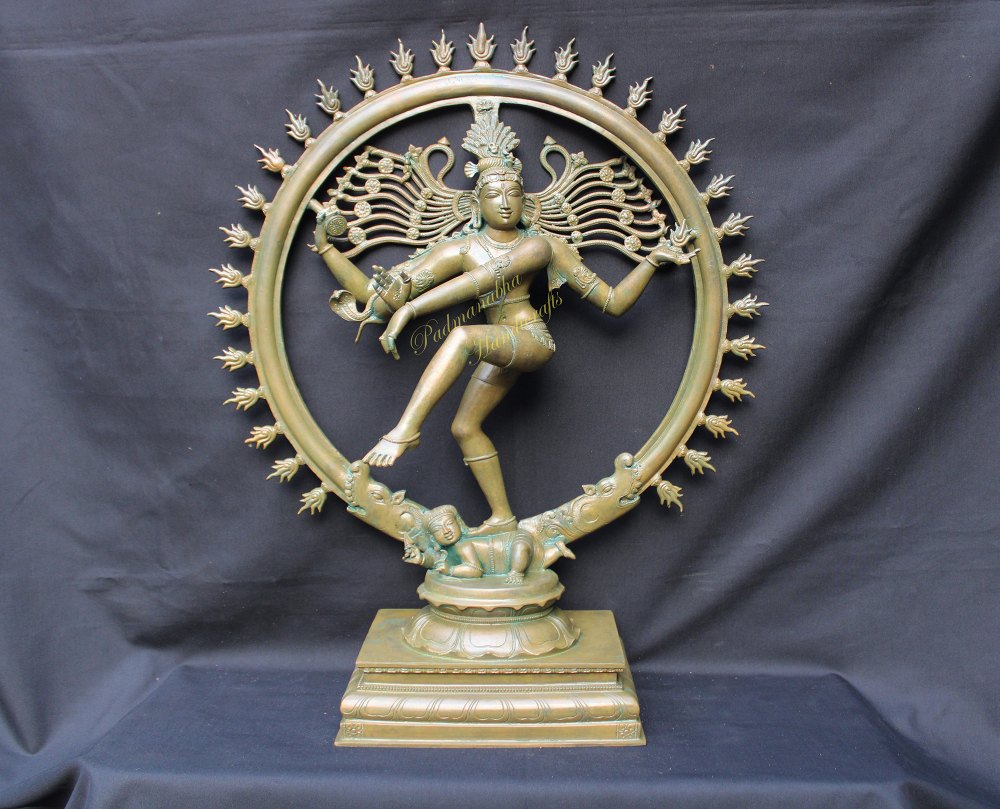
The very stance of Nataraja, with bent legs, is indicative of an energetic and ceaseless dance, a concept deeply rooted in Sanathana Dharma. This posture, sometimes identified as bhujungatrasa, a term found in classical Sanskrit dance treatises, suggests a dynamic interplay of cosmic forces. Complementing this dynamism is the depiction of Shiva’s long, matted hair, or jatas, which fly outwards in thin strands, symbolizing the wildness and ecstasy inherent in his cosmic dance. These matted locks also reflect Shiva’s role as an ascetic, renouncing worldly affairs. Within these flowing tresses resides the goddess Ganga, whose presence signifies the power of Lord Shiva to quell turbulent situations, much like he received the forceful descent of the river Ganga into his hair, and also represents the continuous regeneration of life.
The headdress of Nataraja is often adorned with symbolic elements such as a human skull, representing mortality and the transient nature of existence; a crescent moon, embodying the cycles of time, the bestowal of material pleasures, and the union of the individual soul with ultimate reality; and the flower of Datura metel, an entheogenic plant with symbolic significance.
Typically depicted with four arms, Nataraja showcases the multifaceted power and skills of the divine. Variations with ten arms can also be observed, further emphasizing divine potency.
Adding to the complexity of the symbolism, Nataraja is portrayed with different earrings in each ear – a male crocodile-shaped earring in the right and a circular female earring in the left. This signifies the androgynous nature of the divine, representing the harmonious balance of masculine and feminine energies, and also symbolizes Shiva as the all-encompassing father-mother-guru (Arthanareeswara Shiva).
The third eye on Shiva’s forehead serves as a potent symbol of cosmic knowledge, wisdom, and the ability to perceive beyond the ordinary. A cobra, often seen coiled around Nataraja’s neck or limbs, represents kundalini shakti, the inherent coiled power within every being, as well as Shiva’s mastery over even the most deadly creatures and the cyclical nature of reincarnation.
Despite the dynamic and often fierce imagery, Nataraja’s facial expression remains serene and composed, signifying inner tranquility amidst the cosmic dance of creation and destruction.
The attire typically includes a veshti, a garment worn by priests in Sanathana Dharma. The figure often stands on a lotus base, a symbol of purity in Sanathana Dharma tradition.
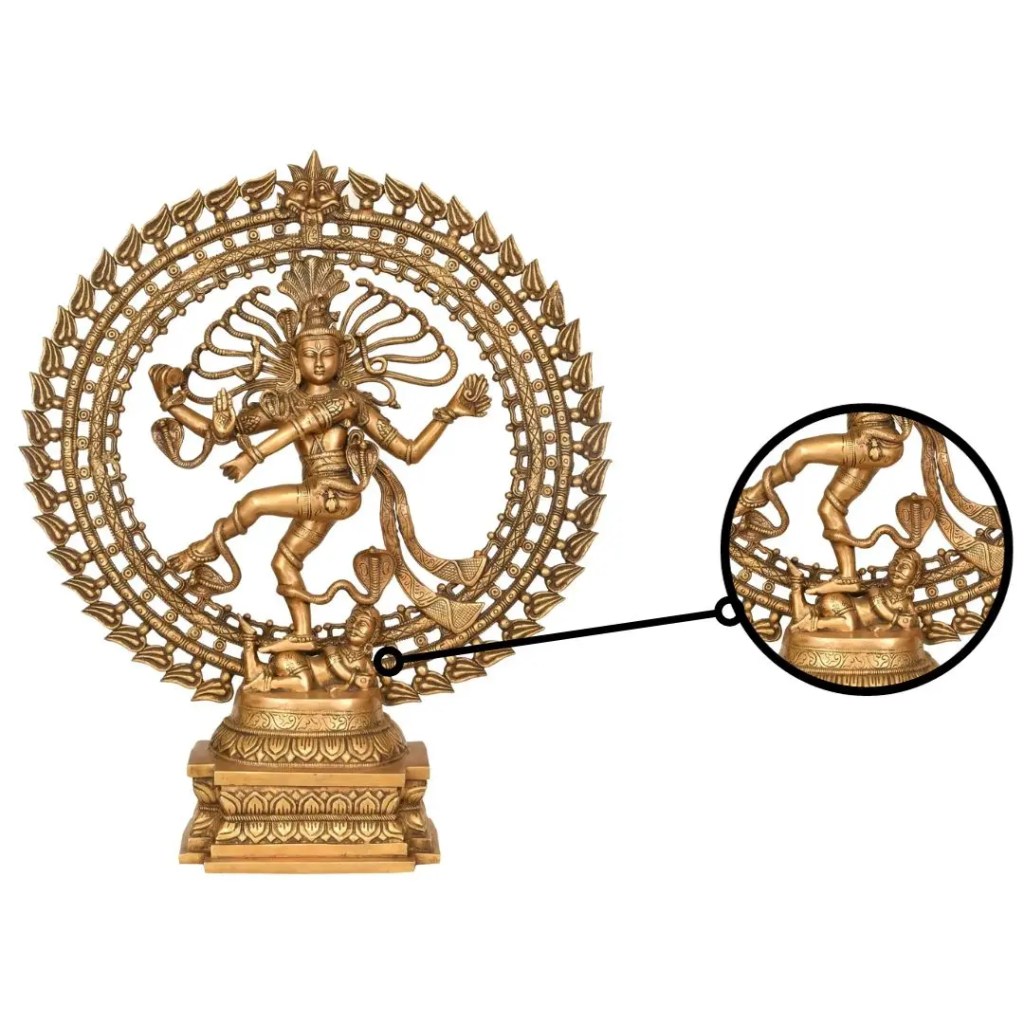
The left leg of Nataraja is lifted, a gesture that symbolizes liberation, upliftment, and offers refuge to the troubled soul. In contrast, the right foot is firmly planted on the dwarf figure Apasmara, who embodies ignorance, ego, illusion, and the forgetfulness that leads mankind astray.
The four arms of Nataraja engage in symbolic gestures, known as mudras, and hold significant objects.
The upper right hand typically holds the damaru, a small hourglass-shaped drum, which symbolizes the primal sound of creation and the rhythm of time. This drum is often associated with the sound “Om,” believed to be the origin of the universe.
The upper left hand holds agni, the flame of destruction and transformation, which also signifies the removal of illusions from the mind.
The lower right hand is raised in abhaya mudra, an open palm facing outward, signifying fearlessness, protection, and the bestowing of blessings upon devotees.
The lower left hand is held across the chest in the gajahasta pose, resembling an elephant’s trunk and pointing towards the raised left foot. This gesture assures devotees of refuge, upliftment, and salvation through Shiva’s grace. This mudra is also interpreted as alluding to wisdom.
Encircling the figure of Nataraja is the prabha mandala, a ring of flames that represents the cosmic fire responsible for the creation and destruction of the universe in an endless cycle. This ring symbolizes the cyclical nature of time, energy, and the immense power of the cosmos. The flames themselves can be seen to represent the dualities of daily existence – good and bad, joy and sorrow. Emerging from mythical water creatures known as makara at each end, the arch of fire sometimes has an inner edge that symbolizes the waters of the ocean. The depiction of the number of flame points evolved over time, from three to five, reflecting changing artistic conventions.
Thus, Shiva as Nataraja is seen as the source of all movement and dynamism within the cosmos. Interestingly, modern physics has found parallels in this ancient symbolism, with the dance of subatomic particles being likened to Shiva’s cosmic dance, suggesting a fundamental rhythm underlying all existence. The presence of a Nataraja statue at CERN, the European Organization for Nuclear Research, further underscores this connection between ancient wisdom and modern scientific understanding of the universe’s fundamental dance.
Tracing the Origins: Archaeological Evidence of Nataraja
The earliest visual representations of a dancing Shiva can be traced back to the 5th and 6th centuries CE. Initial depictions in stone often show Shiva in the chatura tandava pose, a dance posture where both feet are grounded, and notably absent is the dwarf demon Apasmara. This absence can be attributed to excessive focus on the dance posture and gestures in the earliest days. Moreover, the spiritual significance and understanding of Nataraja evolved over time, and with it, Apasmara increasingly became part of Nataraja iconography.
Among the oldest Nataraja sculptures in India are the stone reliefs found in the Ellora and Badami Caves, dating to around the 6th century CE. A partially damaged 6th-century Nataraja can also be found in the Elephanta Caves.
An earlier precedent, though also damaged, is a 5th-century CE open-air sculpture discovered near Vijayawada at Mogalrajapuram.
The classical form of Nataraja, as it is widely recognized today, first appears in a pillar of the rock-cut Avanibhajana Pallaveshwaram Temple at Seeyamangalam, constructed in the 6th century CE during the reign of the Pallava King Mahendravarman I. This sculpture is acknowledged by the Archaeological Survey of India and the Archaeological Survey of Tamil Nadu as the oldest known Nataraja sculpture.
The iconic form of Nataraja as the “Lord of Dance” reached its zenith under the patronage of the Chola dynasty, which ruled from 880 to 1279 CE. During the 8th to 10th centuries, the mature and best-known depictions of Nataraja emerged in Tamil Nadu as exquisite Chola bronzes. Notably, the oldest known Tamil bronze Nataraja, dating to around 800 AD, is housed in the British Museum, a finding that suggests a Pallava origin. Lead isotope analysis further supports this Pallava attribution, dating the image to approximately 800 AD. Scholar Sharada Srinivasan has presented archaeological evidence indicating that Nataraja bronzes and dancing Shiva artwork in South India were indeed a Pallava innovation, tracing back to the 7th to 9th centuries.
Well-formed, three-dimensional stone Nataraja sculptures first appeared during the reign of the Chola queen Sembiyan Mahadevi, around 940 AD.
The influence of Nataraja extended beyond India, with reliefs discovered in various parts of Southeast Asia, including Angkor Wat, Bali, Cambodia, and Central Asia.
Archaeological finds also include a four-foot-tall Nataraja sculpture from the 7th-8th century AD found in Odisha, eastern India , and a red sandstone Nataraja figure from the 9th-10th centuries CE in Ujjain, Madhya Pradesh, now displayed at the Gwalior Archaeological Museum.
The largest monolithic stone Nataraja sculpture, dating to the 11th century CE, was discovered in Udaypur, Madhya Pradesh, and is attributed to the Paramara King Udayaditya.
Chola bronze Natarajas were often created as processional images, designed to be carried during sacred processions and festivals.
Nataraja Through the Ages: Mentions in Sacred Texts and Historical Sources
The concept of Shiva as Nataraja finds mention and elaboration in various Puranas of Sanathana Dharma, providing a rich mythological and theological context for this iconic form.
The Shiva Purana describes Lord Shiva’s five primary actions – creation, destruction, grace, dissolution, and blessing – and identifies Nataraja as one of the twenty-five manifestations of the deity. This Purana also recounts the story of Shiva performing the cosmic dance to subdue the ego of arrogant sages in the Daruka forest.
The Skanda Purana, while primarily focused on Lord Kartikeya, also emphasizes devotion to Shiva and mentions the Nataraja image as being present from the Gupta period onwards. Notably, it describes the Sandhya Tandava, Shiva’s twilight dance, performed on the thirteenth day of the waning moon , and narrates a story of Shiva appearing as Budubudiki, a two-handed Nataraja, in the Shiva Puranam. The Skanda Purana further connects Nataraja to the narratives surrounding the birth and battles of Lord Skanda.
The Linga Purana, which centers on the worship of the Linga, dedicates a chapter to the Shiva Tandava, detailing the cosmic dance in the context of creation and destruction. It narrates the story of the demon Daruka and the emergence of Kaumari Shiva, which culminates in Shiva’s Tandava.
Across the Puranas, Shiva’s Tandava is consistently portrayed as the fundamental source of the universe’s creation, preservation, and dissolution, encompassing both the vigorous Rudra Tandava and the blissful Anand Tandava. The dance of Nataraja is often depicted as a symbolic representation of Shiva’s five essential manifestations: creation, sustenance, transformation, revealing, and concealing.
Early Tamil literature, particularly the devotional hymns of the Tevaram and Thiruvasagam, provides significant textual evidence for the early worship and understanding of Nataraja. The Tirumurai, a collection of Tamil Shaivite texts, identifies Nataraja as the form of Shiva that embodies the functions of creation, destruction, preservation, illusion (maya), and bestowing blessings.
The ancient Tamil Bhakti movement, during the 7th and 8th centuries CE, saw the Nayanar saints, including Sambandar, Appar, and Sundarar, compose numerous hymns in praise of Nataraja, often referencing the temple at Chidambaram as his sacred abode.
The Tevaram, dating back to the 7th century, contains a wealth of devotional poems dedicated to Shiva, with specific mentions of Nataraja’s dance within the Tamil region and especially in Chidambaram.
Similarly, the Thiruvasagam, composed in the 9th century by Manikkavasagar, contains numerous hymns that reference Nataraja and the significance of Chidambaram.
A prominent legend associated with the Thiruvasagam recounts how Lord Shiva himself, disguised as a Tamil man, wrote down the hymns as they were sung by Manikkavasagar in the Chidambaram temple, further solidifying the sacredness of both the text and the deity’s association with the site.
The Uttarakamika agama is another important text that describes the specific poses and iconography of Nataraja.
Nataraja: The originator of Classical Dance forms
The Nataraja avatar is considered the originator of various classical Indian dance forms, with Bharatanatyam being particularly closely associated. As the lord of dance and dramatic arts, Nataraja embodies the very essence of these traditions within Sanathana Dharma. The poses and gestures seen in Nataraja’s iconography, such as the raised leg, the abhaya mudra, and the holding of the damaru, are directly reflected in the movements and expressions of Bharatanatyam. The Nataraja Temple at Chidambaram, a significant site for Nataraja worship, features carvings of the 108 karanas from the Natya Shastra, an ancient treatise on performing arts that forms the foundational vocabulary of Bharatanatyam.
Nataraja in the Modern World: Enduring Significance and Relevance
The Nataraja avatar of Shiva continues to hold profound significance in modern life, extending beyond its religious origins to become a cultural icon within the broader context of Sanathana Dharma. Worshipped in major temples and widely circulated in public life through art and imagery, Nataraja embodies the rich pattern of Indian tradition and profound cosmic principles. Artists continue to draw inspiration from this powerful image, using it in diverse ways to sell products, offer social commentary, and present philosophical concepts rooted in Sanathana Dharma.
Spiritually and philosophically, Nataraja resonates deeply with contemporary individuals seeking meaning and understanding in an increasingly complex world. Representing the triumph of the spiritual over the material and embodying the cyclical nature of time and creation, Nataraja serves as a potent symbol of cosmic energy and offers a profound path towards spiritual grace and liberation within the framework of Sanathana Dharma. The image serves as a constant reminder of the impermanence of worldly existence and the fundamental interconnectedness of all things. In a world often marked by change and uncertainty, Nataraja’s eternal dance provides a powerful framework for embracing life’s rhythms with courage and reverence, ultimately guiding individuals towards inner peace and enlightenment as envisioned in Sanathana Dharma.
Nataraja’s influence extends into various facets of modern culture. It has inspired countless works of art, architecture, and literature, captivating imaginations for centuries. The symbolic connection between Nataraja’s cosmic dance and the dance of subatomic particles has led to the prominent placement of a Nataraja statue at CERN, symbolizing a profound bridge between ancient wisdom and modern science. Even popular culture, such as the Indian television show Nach Baliye, incorporates Nataraja imagery, highlighting its widespread recognition and enduring appeal. Furthermore, the Nataraja pose has been adopted in yoga practice as Natarajasana, or the dancer’s pose, demonstrating its continued relevance in contemporary spiritual and physical disciplines within the traditions of Sanathana Dharma.
Conclusion: The Eternal Dance of Shiva
The Nataraja avatar of Shiva is far more than a captivating representation; it is a profound and multifaceted symbol that encapsulates the core tenets of Sanathana Dharma. From the intricate details of its iconography to its deep roots in archaeological findings and sacred texts, Nataraja embodies the cosmic dance of creation and destruction, the triumph of knowledge over ignorance, and the ultimate path to spiritual liberation as understood within Sanathana Dharma. Its enduring presence in art, culture, science, and spirituality underscores its timeless relevance, continuing to inspire and guide individuals in their understanding of the universe and their place within its eternal, rhythmic dance. The dance of Shiva Nataraja, therefore, remains an eternal source of wisdom and a powerful representation of the dynamic interplay that governs all existence within the philosophical framework of Sanathana Dharma.
 Dharma Jyothi